The short answer
Nærøyfjord cruises are available year-round, but both the timetable and the scenery change with the season: waterfall flow, snow on the mountains and the colour of the slopes all vary through the year. The widest choice of departures runs from late spring through summer, with a reduced timetable in winter. The boats have outdoor decks and heated indoor lounges with panoramic windows, so cold or wet weather does not stop you seeing the fjord.
If your dates are flexible, late May to early June offers the best overall balance for a first visit. Days are very long, the slopes are green, snowmelt feeds the waterfalls, and the busiest summer weeks are still ahead. July and August are the warmest months, and the most in demand.
April is the alternative for long daylight before the summer season starts: about 14 hours of light, and fewer visitors across the region than in May. The landscape is still coming out of winter, though, and the waterfalls are weaker than later in spring. From late September into October, autumn colour becomes the main draw.
Winter is a different trip rather than a reduced one: snow on the mountains, far fewer visitors and very short days. Around the solstice, take the morning departure for the route in daylight: the afternoon sailing runs past sunset. Use the date checker above for your exact day.
- Best overall for a first visit
- Late May to early June
- Strongest waterfalls and long days
- Late May to June
- Longest daylight
- June
- Widest choice of sailings
- Summer
- Quieter long-daylight option
- April
- Autumn colour
- Late September to mid-October
- Snowy winter scenery
- December to March
- Winter departure to choose
- Morning
- Daylight at the fjord about 19 hours in June, 5½ in December
- Departures from Flåm 4 or more from late spring through summer, 2 on the current winter schedule
- Visitor demand across Vestland, an indicator July runs about five times January
What will the fjord be like on your day?
- Rain at Aurland 35 mm across the month
- Air temperature at Vangsnes 10.0 °C average
- Daylight at the fjord 17h 20m
- Sailings a day each way 4, summer timetable
Mid-May sits in the driest stretch of the year at Aurland, with the meltwater waterfalls building and roughly seventeen hours of daylight. Pick a date above and this updates, using the live forecast when your day is close enough for one.
Inside the nine-day forecast window this reads MET Norway's forecast for Flåm and says so; beyond it, the thirty-year station averages. It checks conditions and which timetable is running. It does not know whether a specific departure has seats, which the availability calendar above does.
The four seasons on the Nærøyfjord
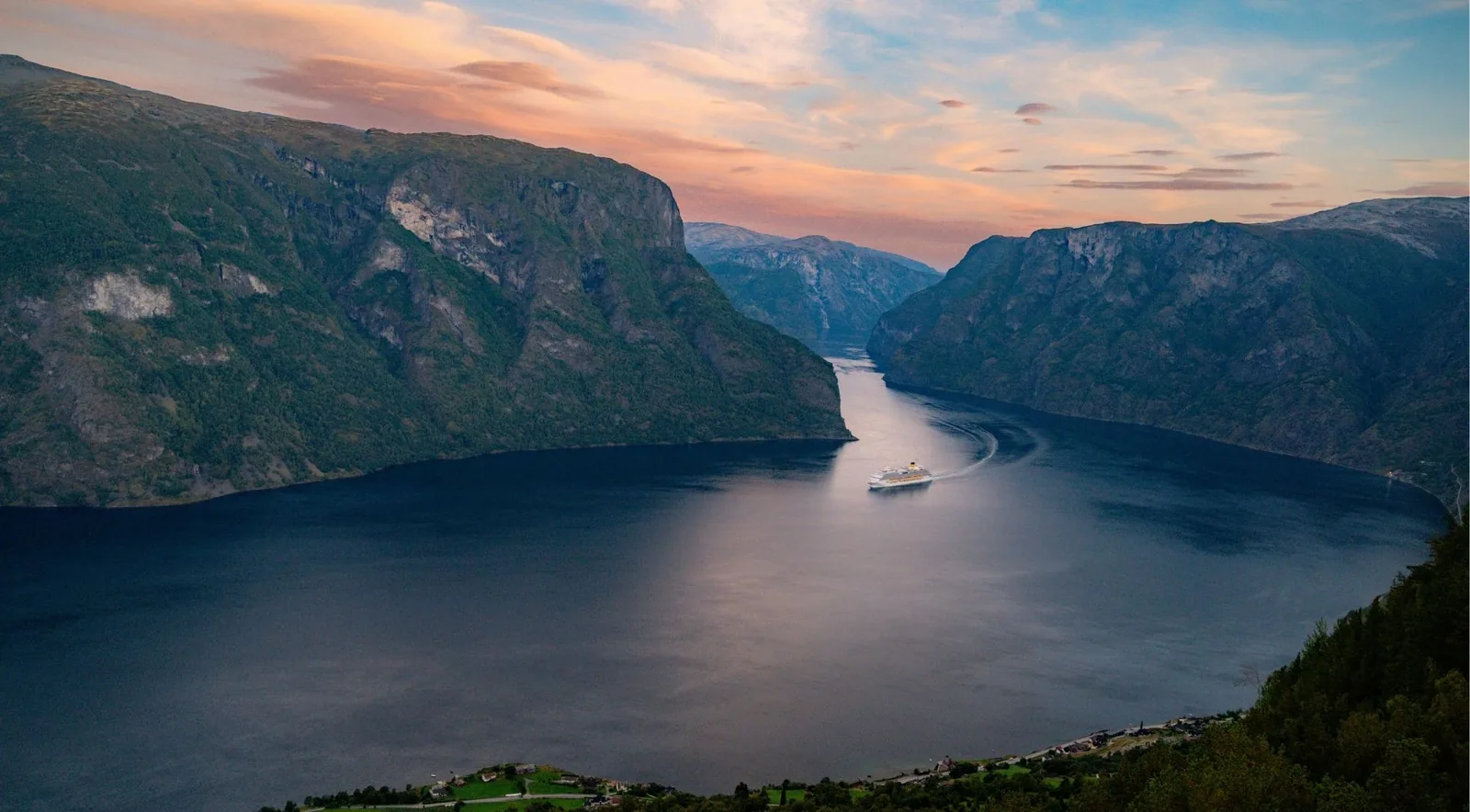
The Nærøyfjord is 17 km of water between walls that rise about 1,400 m on either side, and a sailing is two hours of looking at them. The boats have open viewing decks and heated indoor lounges with panoramic windows, so the season does not really decide whether you can be comfortable for two hours. What it decides is the scenery: waterfall flow, snow on the mountains, the colour of the slopes, and how much daylight you get to see them in.
Late spring, and why it wins for a first visit
One practical note before the case for it: the wider timetable starts on 1 May, so April and the first half of October run the reduced schedule even though neither feels like winter. Late May into early June is the one period where several things line up at once. The snow on the plateau above the fjord is melting hard, so the waterfalls that make the Nærøyfjord photogenic are running at their strongest. The slopes have greened up. Daylight is already past 17 hours, and the main-season timetable has started, so there is a wider choice of sailings. The busiest weeks are still ahead. Drier weather helps too, and it is the smallest of these reasons rather than the headline one.
High summer, for warmth and the fullest programme
July and August are the warmest months, at 16.0 °C and 15.1 °C at Vangsnes. Daylight is already past its peak by then: the maximum is 19h 14m at the June solstice, and mid-August is down to 15h 51m. This is when the choice of tours is widest, and the Viking Village at Gudvangen is open. The costs are real, though: July is the busiest month by a distance, the Flåm Railway is the part of a guided day that sells out first, and the meltwater has largely finished, so the smaller falls are thinner than they were in May.
Autumn, for colour
From late September into mid-October the slopes turn and the low sun sits along the fjord walls for most of the short day. Two things to weigh. September is not the quiet month it is often sold as, as it runs level with May for overnight stays. And it is wetter: 71 mm at Aurland in September against 35 mm in May. The classic ferry operator stops on 15 October.
Winter, for the version most people never see
From roughly November to March the mountains carry snow, the water goes dark, and there are far fewer visitors. This is the season with the strongest search interest after the summer peak, and it has a following of its own — our winter fjord cruise guide covers which departures still run and what changes. Its constraint is daylight rather than cold: 5h 35m at the December solstice means a Bergen day tour has to fit three hours of coach each way plus a two-hour sail into a narrow window. Bergen operators run a separate winter programme for this, and the earliest winter departures we found start on 1 November.
Other Experiences to Plan Around Your Season
Whichever month suits your trip, these are the experiences travellers pair with their fjord cruise. From Bergen, guided days sail the Nærøyfjord and Aurlandsfjord, climb to the Stegastein viewpoint 650 metres above the fjord, stop at Tvindefossen waterfall and Voss, and visit the Njardarheimr Viking Village in Gudvangen. In winter, a dedicated cold-season tour runs the Nærøyfjord cruise and the Flåm Railway under snow-covered peaks.
Month by month
Rain and temperature are thirty-year averages from MET Norway. Rain is measured at Aurland, a scheduled stop on the cruise route; temperature at Vangsnes, 40 km west on the Sognefjord, because Aurland publishes no temperature normal. The crowd column is an indicator built from county accommodation statistics, not a count of people on the boat.
| Month | Rain at Aurland (mm) | Temp at Vangsnes (°C) | Daylight | Crowd indicator (Vestland, Jul = 100) | What you see |
|---|---|---|---|---|---|
| January | 81 | 1.5 | 6h 28m | 19 | Snow on the mountains, dark water, very quiet. Reduced winter timetable. |
| February | 61 | 1.0 | 9h 03m | 23 | The coldest month, and the light is back to nine hours. Best snow odds. |
| March | 56 | 2.5 | 11h 42m | 27 | Snow still high on the walls, days near twelve hours. Quiet. |
| April | 32 | 6.2 | 14h 37m | 30 | Driest month of the year. Thaw starting, falls not yet at full flow. Still on the reduced timetable. |
| May | 35 | 10.0 | 17h 20m | 50 | Meltwater waterfalls building to full flow, slopes greening, dry. |
| June | 40 | 13.4 | 19h 09m | 72 | Longest days of the year, falls still strong, everything running. |
| July | 51 | 16.0 | 18h 23m | 100 | Warmest and busiest. Falls easing as the snowpack runs out. |
| August | 66 | 15.1 | 15h 51m | 89 | Still warm and busy, wetter than July, days shortening quickly. |
| September | 71 | 11.7 | 12h 59m | 49 | Autumn colour arriving, low light along the walls. Wetter. |
| October | 79 | 7.2 | 10h 11m | 32 | Colour at its best early on. Winter timetable takes over during the month. |
| November | 75 | 4.4 | 7h 24m | 26 | First snow on the tops, short days, winter tour programme starts. |
| December | 87 | 1.9 | 5h 39m | 22 | Wettest and darkest month. Snow low on the cliffs when it is cold. |
Waterfalls and the thaw
The waterfalls along the Nærøyfjord and Aurlandsfjord are fed by snow melting off the plateau above the fjord, not by rain falling on it. That distinction matters, because it explains why the biggest waterfall weeks are also among the driest weeks of the year, not the wettest. Flow builds as the thaw gets going through May, holds into June while there is still snow up there to melt, and then thins through the summer as the snowpack runs out. By September many of the smaller falls have dropped to a trickle, even though September gets twice April's rain.
We have not named a peak week for this. The mechanism is clear and the direction is not in doubt, but no published discharge series for the Nærøyfjord catchment was available to check a specific date against, and a week invented to sound precise would be worth less than the pattern. One caution on a nearby landmark: Kjosfossen, the waterfall the Flåm Railway stops at, is partly regulated by a hydroelectric plant, so its flow does not track the thaw as directly as the fjord's own falls do.
Rain, and why the fjord beats Bergen
The Norwegian fjords have a reputation for rain. It is mostly Bergen's reputation. Bergen is one of the wettest cities in Europe: the thirty-year average at the Bergen - Florida station is about 2,456 mm a year. Aurland, on the cruise route itself, has an annual normal of about 734 mm, under a third as much. The mountains between the coast and the inner Sognefjord wring most of the moisture out of the weather before it reaches the fjord.
For a reader planning a day trip out of Bergen, that has a practical shape: the wet part of the day is more likely to be the city you left than the fjord you came for. It does not promise a dry sailing. These are monthly totals, not the chance of rain on your particular afternoon, and 32 mm in April is an average across thirty Aprils, not a guarantee about yours. A figure like 32 mm is the total depth of rain across a whole month, not a daily rate, and it says nothing about how many days were wet: a month can reach it in one afternoon or drizzle its way there over three weeks. What it does mean is that the fjord end of the trip is drier than most visitors expect, and that April, May and June are the three driest months of its year.
Bring a windproof layer whatever the month, because the best views are from the open deck and the boat generates its own wind. You can retreat to the heated panoramic lounge when you have had enough, which is the part that makes a winter sailing workable. Stegastein at 650 m has no such option and is colder and more exposed than the water. Our fjord cruise packing guide goes through it season by season.
Daylight and the winter day tour
Daylight moves more than anything else here across the year: 19h 14m at the June solstice at Gudvangen, 5h 35m at the December solstice. The sun rises every day of the year, because the Nærøyfjord sits about 634 km south of the Arctic Circle. There is no polar night to plan around, and no midnight sun either, whatever the photographs of northern Norway suggest.
Where this bites is on a guided day from Bergen, which is roughly three hours of coach each way around a two-hour sail. In June that fits inside the day with hours to spare. In December it does not fit inside the light at all, so part of the driving happens in the dark and the sail has to be scheduled into the middle of the day. That is the reason the Bergen operators sell a separate winter product instead of running the summer one on a shorter timetable. It is also why the departure time stops being a detail: the winter schedule runs a morning sailing and a mid-afternoon one, and with sunset at about 15:18 in late December the afternoon boat sails into the dark while the morning one does not.
How busy each month gets
Statistics Norway publishes overnight stays by county and month, and averaged across 2023 to 2025 the Vestland series runs from about 204,000 guest nights in January to about 1.09 million in July. July is more than five times January.
One finding contradicts how the shoulder season is usually described. May and September are the same: about 541,000 guest nights against about 536,000, a difference of roughly one per cent, both at around half of July. September does not empty out more than May does. If you are choosing between them, choose on what you want to see, because the crowd argument does not separate them. The month that is genuinely quieter than both is April, at about 330,000.
Treat all of this as an indicator, not a measurement of your sailing. It counts overnight stays anywhere in a county that includes Bergen and its business travel, and it does not count day visitors, coach passengers or anybody standing on the deck of the Nærøyfjord boat. It shows the shape of the season reliably. It cannot tell you how full your departure will be.