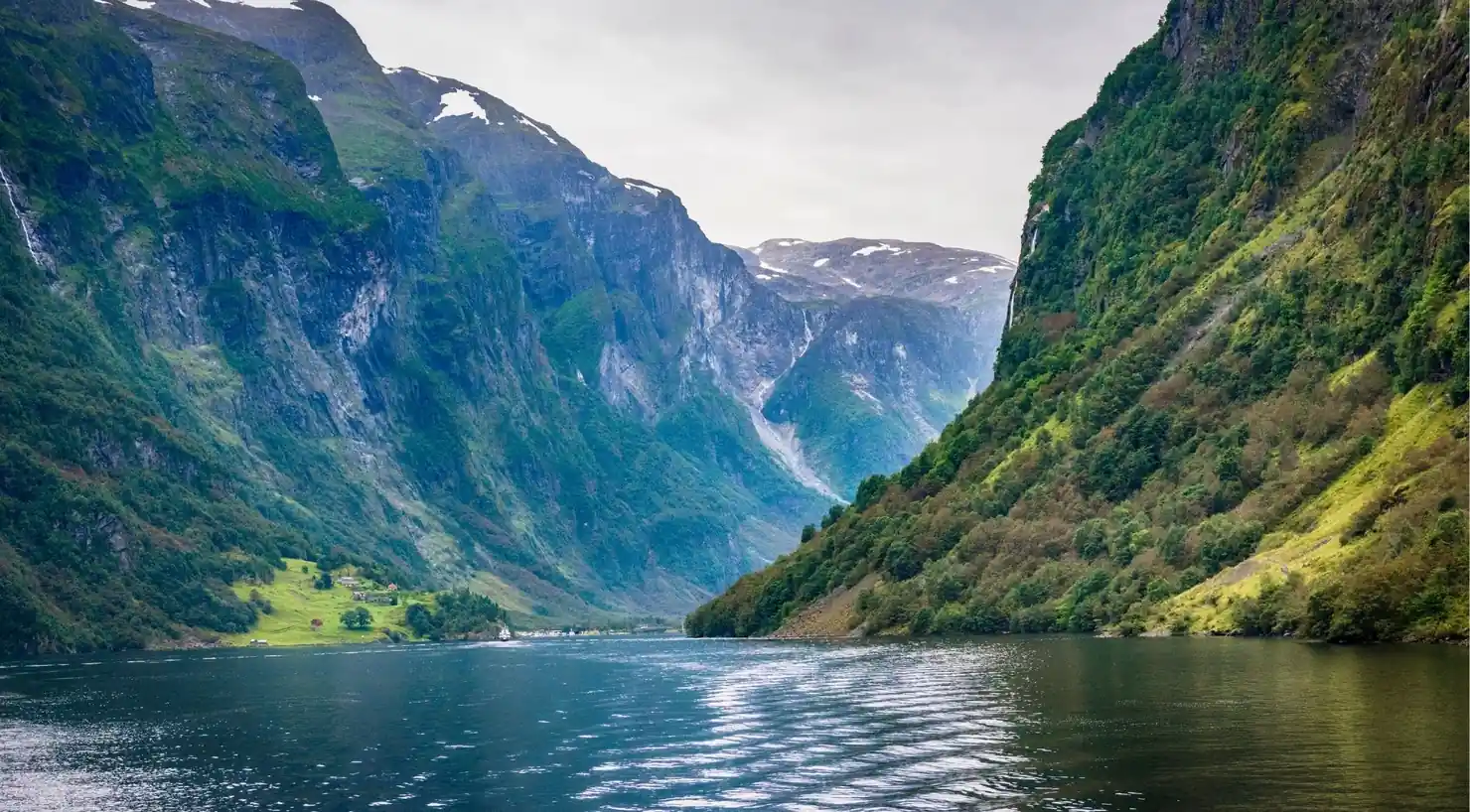
On a diesel boat you hear the engine. On the Nærøyfjord's electric catamarans you hear the water against the hull, the waterfalls and your own voice echoing off the fjord walls. That change is now the law: a 2026 rule makes the Nærøyfjord and Aurlandsfjord, in practice, all-electric fjords for the boats that sail them.
The calendar below shows live dates for the Viking Village, Nærøyfjord Cruise & Flåm Railway day from Bergen. Its listing names the all-electric Future of the Fjords as the boat for the two-hour Nærøyfjord cruise, although, as on any Nærøyfjord sailing, the operator can swap boats.
What a silent cruise is like
The biggest change is the missing diesel engine. Captain John Nauckhoff of Future of the Fjords has said that because the boat runs on battery alone, "the only thing you hear is the propellers hitting the water surface." John Vonli, managing director of The Fjords, described the all-electric boats as "clean and silent", letting passengers "glide effortlessly over the water and come closer to nature than ever before."
Travellers say the same. One review of the Nærøyfjord cruise notes that "because it uses electricity, there's almost no engine sound … the ship walked quietly." Fjord Norway's own feature on silent cruising describes what happens without "the heavy vibration and engine noise of a traditional vessel": "conversations become softer. Guests notice smaller sounds: water against the hull, birds overhead, wind moving through the fjord and the voices of the guides." The silence, it argues, "sharpens attention", turning sightseeing "from passive consumption into quiet observation."
There is a benefit below the surface too, though it needs stating carefully. "Reducing underwater noise can mean less disturbance for marine life in sensitive coastal environments," says Brim Explorer, quoted by Fjord Norway, and Brim switches to silent electric mode as it nears whales "to get closer without disturbing them." These claims come from operators and travel journalists. They are plausible and consistent, but we found no peer-reviewed study of wildlife behaviour around these particular fjord boats, so the fair way to put it is less disturbance, not none.
For you on board, it adds up to quieter open decks, audio guides you can actually hear (The Fjords and the Geiranger operators both run multilingual app-based guides), and no diesel fumes, which helps if you are prone to seasickness, since fumes and vibration are common triggers.
Where to take an electric fjord cruise in 2026
Five places offer electric or hybrid-electric sightseeing boats this year. On the Nærøyfjord and Aurlandsfjord, the sightseeing boats are now almost all battery-electric.
- Nærøyfjord and Aurlandsfjord (Flåm to Gudvangen). About two hours one way, all year, with more frequent departures in summer, on The Fjords' (Norway's Best) electric Vision-class boats. You can book one way or a round trip with the connecting shuttle bus, and a new evening Aurlandsfjord cruise runs in July and August. For 2026, Visit Bergen listed a one-way adult Nærøyfjord fare of about NOK 550 (child about NOK 275, family about NOK 1,365), and one traveller report put The Fjords' own one-way fare at about NOK 595. Fares move with the season, so check the live price before you go. The Viking Village, Nærøyfjord Cruise & Flåm Railway day from Bergen (4.8 from more than 1,450 reviews, from $421) includes the cruise, and its listing names Future of the Fjords as the boat.
- Lysefjord from Stavanger. About three hours, all year, on Rødne's electric Rygerelektra or Brim Explorer's Silent Lysefjord & Pulpit Rock cruise. Rødne's is on GetYourGuide as the electric fjord cruise to the Lysefjord and Preikestolen (4.6 from more than 10,000 reviews), and Brim Explorer's as the Lysefjord and Preikestolen cruise by hybrid ship (4.8 from 460 reviews).
- Geirangerfjord. A 75-minute classic tour or a two-hour silent cruise on the hybrid-electric Geirangerfjord III, plus one-way sailings from Ålesund to Geiranger. The season is weighted to summer. Both the classic tour and the silent two-hour hybrid cruise are sold as the Geiranger fjord and waterfalls sightseeing cruise (4.3 from more than 1,800 reviews), and the round trip from Ålesund to the Geirangerfjord also uses a hybrid-electric boat (4.8 from more than 850 reviews).
- Oslofjord. Brim Explorer's MS Brisen runs silent sightseeing, dinner and brunch cruises from Rådhusbrygge, from about NOK 690 for the highlights cruise to about NOK 1,490 for dinner. The guided sightseeing cruise on MS Brisen rates 4.7 from more than 2,000 reviews, and Brim's three-course dinner and live music cruise rates 4.5 from more than 500.
- Tromsø and Lofoten. Brim Explorer runs silent whale-watching and aurora dinner cruises (about NOK 1,990), and silent electric cruises run into the Trollfjord from the Lofoten area. The Tromsø whale-watching tour by hybrid-electric boat rates 4.5 from more than 6,600 reviews, and the silent Trollfjord cruise from Svolvær 4.8 from more than 3,700.
More Ways onto Norway's Fjords
From Flåm you can sail the Nærøyfjord to Gudvangen, ride the Flåm Railway or take a small RIB boat under the waterfalls. From Bergen, guided day tours combine the electric cruise with the Stegastein viewpoint above the Aurlandsfjord, and further afield you can cruise the Lysefjord below Pulpit Rock or the Geirangerfjord from Ålesund. Live options are below.
The boats on the Nærøyfjord
The boats that changed the Nærøyfjord are a family of carbon-fibre catamarans built by Brødrene Aa in Hyen for The Fjords. The figures below come from the builder, class societies, the operator and the maritime press; where sources disagree, we say so.
| Boat | Power | Battery | Size and passengers |
|---|---|---|---|
| Vision of the Fjords (2016) | Diesel-electric hybrid: two 150 kW electric motors, two 749 kW diesel gensets (MAN engines) | 600 kWh (ZEM) | 40 m long, 15 m beam, 399 passengers |
| Future of the Fjords (2018) | Fully electric: two 450 kW motors, cruising at 16 knots | 1,800 kWh (1.8 MWh) | About 42 m (40 to 42.5 m cited), 400 passengers |
| Legacy of the Fjords (2020) | Fully electric: two 450 kW motors, 16 knots | 1,800 kWh (Westcon) | 42.23 m long, 15.5 m beam, 2 m draught, about 769 t, 400 passengers |
| Spring of the Fjords | Battery system due in autumn 2026 | Not yet published | Not yet published |
Vision of the Fjords
The first of the family, and Ship of the Year in 2016. Vision runs on battery alone inside the Nærøyfjord and on diesel for the transit between the Nærøyfjord and Flåm, which makes it the clearest example of the hybrid caveat further down this page.
Future of the Fjords
The first fully electric boat on the route, and Ship of the Year in 2018. Its battery is 1,800 kWh, the figure given by the builder, by Danfoss (8 racks of 17 modules) and by the boat's chief engineer. Some outlets cite "1,900 kWh" or "2.0 MWh", but the installed figure that can be verified is 1.8 MWh. It reportedly cost about NOK 144 million (about US$17 million) to build, roughly 60% more than Vision, with NOK 17.8 million (about US$2.1 million) of support from Enova.
Legacy of the Fjords
A near-identical sister to Future, delivered in 2020, with a 1,800 kWh battery pack from Westcon. It cost about NOK 130 million (about US$13.8 to 14.5 million) to build, adds three onboard conference areas, and can charge and load from either side. Its IMO number is 9870422.
Spring of the Fjords
The Fjords' own booking pages say Spring of the Fjords "will be fitted with a battery system in autumn 2026", after which "it too will operate fully electrically." As of the 2026 season the retrofit is scheduled, not confirmed as complete, and the battery size has not been published.
How the boats charge: the PowerDock at Gudvangen
Charging was the hard part. The boats need about 2.4 MW of charging power, and the local grid at Gudvangen could supply only about 1.2 MW, roughly half. So The Fjords and Brødrene Aa built the PowerDock, a floating glass-fibre dock 40 metres long and 5 metres wide. Its own battery trickle-charges from the grid through the day and then delivers a fast charge to the boat, recharging it in about 20 minutes and delivering roughly 800 kWh each time. The dock also stores supplies and the fuel for the hybrid Vision, and takes the boats' grey and black water for treatment ashore, which solved the problem of sewage discharge in the fjord.
You will see the dock's battery described two ways. DNV, Riviera and many other outlets call it a "2.4 MWh battery pack". The detailed MoZEES technical paper and Danfoss give the dock battery as 700 kWh, with a total charging capacity of 2.4 MW (1.2 MW from the battery plus 1.2 MW from the grid). The second reading is the more precise: the widely repeated "2.4 MWh battery" seems to mix up power with stored energy.
Electric boats elsewhere in Norway
Rødne, in Stavanger and Bergen
Rygerelektra, delivered by Brødrene Aa in April 2020, is a fully electric carbon-fibre catamaran of about 42 metres, carrying 297 passengers on a 2.0 MWh battery and two 375 kW motors. It is limited to about 19.9 knots in service (it reached 23 knots in trials) and cruises the Lysefjord from Stavanger; Rødne says it saves about 270,000 litres of diesel a year. A separate all-electric "combi" catamaran, Rygerlys, is due to join the Lysefjord service in summer 2026.
For Bergen, Rødne has ordered a new hybrid sightseeing boat, Rygerstraum, for about 300 passengers, to be built by Oma Baatbyggeri and delivered in the second quarter of 2027. It will run on batteries in and out of Bergen harbour and through Mostraumen, on the route of the Mostraumen fjord cruise, and on diesel for parts of the cruise, with a planned later upgrade to full battery operation.
Geiranger
Geiranger Fjordservice (Visit Geiranger) introduced a new hybrid-electric carbon-fibre catamaran, Geirangerfjord III, for about 280 passengers in 2026. It runs a two-hour "silent" cruise, while the smaller MS Geirangerfjord, for about 165 passengers, runs the 75-minute classic tour. Separately, the local operator Bonseye has run three small electric "HyFoil" boats with Evoy electric outboards in Geiranger since 2024.
Brim Explorer: Oslo, Tromsø, Lofoten, Bodø and Svalbard
Brim Explorer was founded in 2018 by Agnes Árnadóttir and Espen Larsen-Hakkebo and runs a fleet of five purpose-built electric and hybrid-electric boats. MS Brisen (2021), a hybrid-electric catamaran for up to 145 guests, runs silent cruises on the Oslofjord. The fleet also runs the Silent Lysefjord & Pulpit Rock cruise from Stavanger and silent whale-watching from Tromsø, using an underwater drone and a hydrophone.
The law, in detail
- The rule and who made it. The requirement sits in the Environmental Safety Regulations (the Regulations on environmental safety for ships and mobile offshore units). The Norwegian Maritime Authority (Sjøfartsdirektoratet) adopted the provisions on behalf of the Ministry of Climate and Environment and formally enacted them on 14 April 2025. Alf Tore Sørheim, Director General of Shipping and Navigation, said the rules provide "the clarity the industry has long awaited". The Minister of Climate and Environment, Andreas Bjelland Eriksen, called them "a significant breakthrough for the World Heritage fjords".
- The 2018 resolution. The Storting, Norway's parliament, adopted the underlying zero-emission resolution on 17 May 2018: resolution No. 672, with the related No. 690. It required emissions to stop "as soon as technically possible and no later than 2026". UNESCO welcomed it as making the fjords "among the world's first zero-emission zones at sea".
- The dates. From 1 January 2026 the rule applies to passenger ships under 10,000 gross tonnes, and from 1 January 2032 to ships of 10,000 gross tonnes and above.
- The five fjords. The Nærøyfjord, Aurlandsfjord, Geirangerfjord, Sunnylvsfjord and Tafjord, which make up the West Norwegian Fjords World Heritage property. The Nærøyfjord and Geirangerfjord were inscribed in 2005.
- Biogas and shore power. The government decided that passenger ships may use biogas as a transitional fuel, kept separate from fossil fuel until it is bunkered, and that ships must use shore power wherever it is available. According to Lloyd's Register, biogas remains allowed after 2032 if it achieves a 50 to 65% cut in greenhouse gases (depending on when it was produced) and is not made from food or feed crops. Zero-emission fuels such as green hydrogen or ammonia must achieve at least a 70% cut under the EU methodology.
- Exemptions. The Maritime Authority may grant a temporary exemption to an individual ship under 10,000 gross tonnes only if all of these apply: the ship sailed in the fjords in 2024 and every year since; it meets every other requirement; the company shows it cannot comply only because shore power is unavailable; and it has a credible plan to get shore power. An exemption lasts up to two years at a time and cannot be extended beyond 31 December 2029. There is a separate, narrow exemption for vessels formally protected as cultural heritage.
- Enforcement. The rule is backed by the Pollution Control Act (Forurensningsloven) and enforced by Sjøfartsdirektoratet, which can ban a ship from operating, fine it or detain it. As of mid-2026 we found no public record of any enforcement action, fine or detention, and no record of a temporary exemption granted to a named ship, so treat both as unconfirmed either way.
Why large cruise ships have until 2032
The 2018 resolution meant all ships would be zero-emission by 2026. In a decision announced on 30 September 2024 and finalised in the April 2025 regulation, the government split the timeline: ships under 10,000 gross tonnes from 2026, larger ones from 2032. State Secretary Astrid Hoem explained that "the technology for zero-emission solutions is more commercially mature for smaller vessels, and it has been necessary to implement different phase-in timelines". The ministry also noted that several cruise lines had recently invested in ships fuelled by LNG. Because even small ocean cruise ships exceed 10,000 gross tonnes, the 2026 rule in practice binds sightseeing boats and ferries, and mainstream cruise ships can keep sailing the fjords until 2032.
Reactions split sharply. Operators who had already gone electric felt let down: Lasse Vangstein of Havila Voyages called the postponement "a scandal", saying "the authorities gave us industry players many years to develop solutions, and we delivered" (Skift, 30 July 2025). Havila's chief executive, Bent Martini, had earlier called the delay "a victory for those who didn't dare to invest in a greener future" (Forbes, 28 August 2024). The trade body Cruise Norway warned of a loophole: "there is growing concern around vessels anchoring outside the protected zone and transporting guests overland without being subject to the same emission standards."
The government defended the phased approach as a balance between environmental ambition, the maturity of the technology, and how much ports such as Flåm and Geiranger rely on cruise traffic, and some local port authorities welcomed it, including Stranda, which runs Geiranger's port. Geiranger has since moved to cap its own cruise traffic: Pierstop's 2026 guide gives a limit of five ships and 8,000 cruise passengers a day, with more than 120 port calls still scheduled for the 2026 season.
Why it happened
UNESCO inscribed the West Norwegian Fjords in 2005. Cruise traffic then grew in fjords too narrow to disperse it, and the Norwegian Maritime Authority warned that air quality in the confined Geirangerfjord could at times be "downright hazardous" (reported by CleanTechnica on 6 January 2024). According to the Western Norway Research Institute, quoted by Business Norway, "cruise ships in Norway consume about 170 million litres of fuel a year – accounting for nearly 3 per cent of the country's overall greenhouse gas emissions. Most of the fuel is burned at sea, but around 20 per cent – or nearly 34 million litres – is burned while the ships are in port." Geiranger alone receives around 800,000 visitors a year, two in five of them (40%) arriving by cruise ship, and tourism there brings in roughly US$22 million a year.
The IUCN World Heritage Outlook's 2020 assessment rated the site's conservation outlook as "good": the geology and scenery behind the listing were "not under any significant threat". It flagged, though, that "some other aspects of the environment and visitor experience may be affected by the increasing number of cruise ships", including harbour development and air and water pollution, and rated cumulative impacts a "high threat". UNESCO's World Heritage Marine Programme has described how the ships' "smoke stacks pollute the air", and paired the fjords with Glacier Bay in Alaska to share ways of reducing the damage. Local complaints about health and visibility, along with this international attention, led to the 2018 political decision.
The honest caveats
- A hybrid is not fully electric. Vision of the Fjords, and Rødne's coming Rygerstraum, run on diesel outside the protected zone and switch to battery inside it. The silent, zero-emission experience is only guaranteed where and when the boat is running on batteries.
- Not every boat has been converted. Spring of the Fjords is not due for its batteries until autumn 2026.
- You may not get the boat you expected. Operators can swap boats and even cancel or reroute at short notice, and winter ice on the Nærøyfjord is explicitly flagged. One TripAdvisor reviewer reported a same-day cancellation for "technical issues". You cannot count on sailing on a particular named boat.
- Large cruise ships have until 2032. The 2026 rule does not clear diesel cruise ships out of the fjords. Most are over 10,000 gross tonnes and remain legal until 1 January 2032, and there is a documented concern about ships anchoring just outside the protected zone.
- "Zero emission" means at the point of use. The boats emit nothing locally, but the claim relies on Norway's electricity: 88.2% hydropower in 2022 (about 129 TWh, according to Statistics Norway) and about 98 to 99% renewable overall. The Norwegian Water Resources and Energy Directorate (NVE) put normal annual hydropower production at 137.6 TWh out of a total of about 157 TWh at the start of 2025. That is genuinely low-carbon, but it is a point-of-use claim, not a full life-cycle one: making the batteries and the carbon-fibre hulls has its own footprint.
What it means for your trip
Expect quieter decks, multilingual audio guides you can hear, and no diesel fumes, which is a real plus if you get seasick. The electric boats are marketed as a premium product, but core Nærøyfjord fares are still in a normal range for a sightseeing cruise, a few hundred kroner one way, so going electric has not obviously pushed ticket prices up. The Fjords (Norway's Best) markets specific premium boats on the Nærøyfjord, and in Geiranger the two-hour silent hybrid cruise is sold separately from the classic 75-minute tour, so you can usually choose the type of experience, but not always the exact boat.
If the electric boat matters to you, book directly with The Fjords or a tour that names their boats, and check the departure on the day, especially in winter. If you are choosing between fjords, our comparison of the best fjord cruises in Norway ranks the electric options alongside scenery, access and price, and our Flåm to Gudvangen guide covers the route itself.
What could change by 2027
- Spring of the Fjords: the battery retrofit is scheduled for autumn 2026 and not yet confirmed as complete.
- Shore power in Flåm: the government committed NOK 100 million in 2024. An earlier Enova grant of NOK 27 million was part of a project costed at about NOK 83 million, including a subsea cable from Aurland's hydropower station. The contract for a 16 MVA shore-power system went to PSW Power & Automation, and Flåm is extending its quay to provide three shore-power connections. The best evidence points to the full cruise-ship facility opening for the 2027 season, not in 2026, but the date is unconfirmed.
- Rygerstraum: Rødne's hybrid boat for Bergen and Mostraumen is due in the second quarter of 2027.
- Enforcement and exemptions: no enforcement actions and no individual exemptions had been confirmed as of mid-2026.
- The 2032 date: if the government brings forward the deadline for large ships, if Flåm's shore power comes online, or if a named exemption is granted, the caveats above will change, and so will this page.
How we know. We relied on official sources (sdir.no, regjeringen.no, whc.unesco.org and the IUCN), class societies (Lloyd's Register and DNV), the builder and operators (Brødrene Aa, Norway's Best and The Fjords, Rødne and Brim Explorer) and the maritime press. The verifiable battery figures are 1.8 MWh for Future and Legacy of the Fjords, 600 kWh for Vision of the Fjords and 2.0 MWh for Rygerelektra; the Gudvangen PowerDock is best described as 2.4 MW of charging capacity with a dock battery of about 700 kWh, and pages quoting "2.4 MWh" or "1,900 kWh" boat batteries have the figures muddled. The Fjords has been wholly owned by Norway's Best Group since May 2024, when the group bought Havila's remaining 50% stake (completion was reported on 2 to 3 May 2024). Three things remain uncertain: the opening date of Flåm's shore power, whether any exemption or enforcement action has happened since 1 January 2026, and the specification and completion of the Spring of the Fjords retrofit. The wildlife benefits come from operators and the travel press, not a fjord-specific study. The 2026 cruise-call counts and Geiranger's daily cap come from commercial cruise guides (Pierstop and Cruisebound), not official port statistics, so treat them as approximate. Fares are indicative and dated; check the live price before you book. naeroyfjordcruise.com may earn a commission from GetYourGuide bookings made through our links, at no extra cost to you.